CRM Articles: Envíos recientes
Mostrando ítems 61-80 de 656

Topological Entropy, Sets of Periods, and Transitivity for Circle Maps
Transitivity, the existence of periodic points, and positive topological entropy can be used to characterize complexity in dynamical systems. It is known that, for every graph that is not a tree and any epsilon > 0, there ...
Convergence of generalized MIT bag models to Dirac operators with zigzag boundary conditions
This work addresses the resolvent convergence of generalized MIT bag operators to Dirac operators with zigzag type boundary conditions. We prove that the convergence holds in strong but not in norm resolvent sense. Moreover, ...
Free decomposition spaces
We introduce the notion of free decomposition spaces: they are simplicial spaces freely generated by inert maps. We show that left Kan extension along the inclusion takes general objects to M & ouml;bius decomposition ...
Fractional wave equation with irregular mass and dissipation
In this paper, we pursue our series of papers aiming to show the applicability of the concept of very weak solutions. We consider a wave model with irregular position-dependent mass and dissipation terms, in particular, ...
Hirzebruch-Zagier classes and rational elliptic curves over quintic fields
Conditionally on a conjecture on the & eacute;tale cohomology of Hilbert modular surfaces and some minor technical assumptions, we establish new instances of the equivariant BSD-conjecture in rank 0 with applications to ...

A criterion for the holomorphy of the curvature of smooth planar webs and applications to dual webs of homogeneous foliations on PC2
Let d >= 3 be an integer. For a holomorphic d-web W on a complex surface M, smooth along an irreducible component D of its discriminant Delta(W), we establish an effective criterion for the holomorphy of the curvature of ...
Sparse gradient bounds for divergence form elliptic equations
We provide sparse estimates for gradients of solutions to divergence form elliptic partial differential equations in terms of the source data. We give a general result of Meyers (or Gehring) type, a result for linear ...
On a variant of Hilbert's 16th problem
We study the number of limit cycles that a planar polynomial vector field can have as a function of its number m of monomials. We prove that the number of limit cycles increases at least quadratically with m and we provide ...
Entropy numbers and box dimension of polynomials and holomorphic functions
We study entropy numbers and box dimension of (the image of) homogeneous polynomials and holomorphic functions between Banach spaces. First, we see that entropy numbers and box dimensions of subsets of Banach spaces are ...
Heat source determining inverse problem for nonlocal in time equation
In this paper, we consider the inverse problem of determining the time-dependent source term in the general setting of Hilbert spaces and for general additional data. We prove the well-posedness of this inverse problem by ...
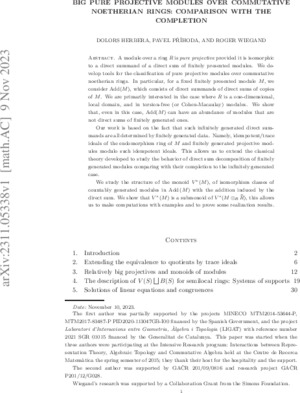
Big pure projective modules over commutative noetherian rings: Comparison with the completion
A module over a ring R is pure projective provided it is isomorphic to a direct summand of a direct sum of finitely presented modules. We develop tools for the classification of pure projective modules over commutative ...
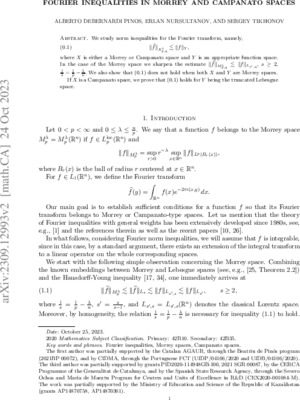
Fourier inequalities in Morrey and Campanato spaces
We study norm inequalities for the Fourier transform, namely, ||(f) over cap||(lambda)(Xp,q) less than or similar to ||f||Y, (0,1) where Xis either a Morrey or Campanato space and Y is an appropriate function space. In the ...
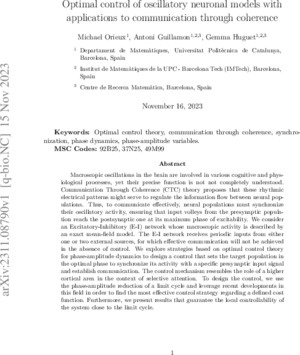
Optimal control of oscillatory neuronal models with applications to communication through coherence
Macroscopic oscillations in the brain are involved in various cognitive and physiological processes, yet their precise function is not completely understood. Communication through coherence (CTC) theory proposes that these ...
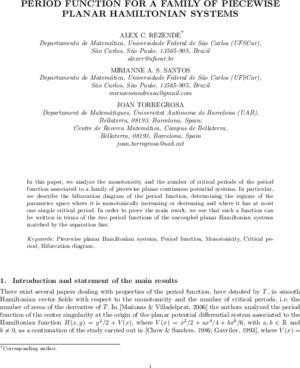
Period Function for a Family of Piecewise Planar Hamiltonian Systems
In this paper, we analyze the monotonicity and the number of critical periods of the period function associated with a family of piecewise planar continuous potential systems. In particular, we describe the bifurcation ...

Rapid, systematic updating of movement by accumulated decision evidence
Acting in the natural world requires not only deciding among multiple options but also converting decisions into motor commands. How the dynamics of decision formation influence the fine kinematics of response movement ...

Regular ring properties degraded through inverse limits
We give a number of constructions where inverse limits seriously degrade properties of regular rings, such as unit- regularity, diagonalisation of matrices, and finite stable rank. This raises the possibility of using ...

Seasonal hotspots of beach litter in the North-East Atlantic linked to aquaculture and river runoff
Macroplastic pollution is a pervasive global environmental challenge, adversely affecting marine ecosystems, wildlife and human health. Understanding temporal variations is crucial for identifying pollution sources and ...
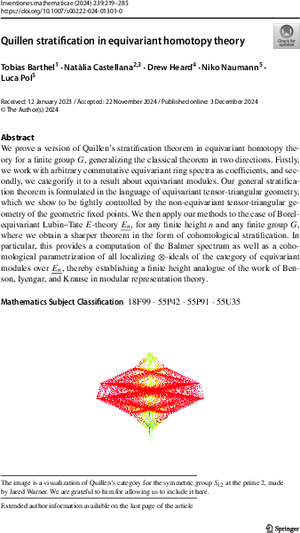
Quillen stratification in equivariant homotopy theory
We prove a version of Quillen’s stratification theorem in equivariant homotopy theory for a finite group G, generalizing the classical theorem in two directions. Firstly, we work with arbitrary commutative equivariant ring ...

A dynamical study of Hilda asteroids in the Circular and Elliptic RTBP
The Hilda group is a set of asteroids whose mean motion is in a 3:2 orbital resonance with Jupiter. In this paper, we use the planar Circular Restricted Three-Body Problem (CRTBP) as a dynamical model and we show that there ...
Sun-Jupiter-Saturn System May Exist: A Verified Computation of Quasiperiodic Solutions for the Planar Three-Body Problem
In this paper, we present evidence of the stability of a model of our Solar System when taking into account the two biggest planets, a planar (Newtonian) Sun-Jupiter-Saturn system with realistic data: masses of the Sun and ...
